De Coloribus
Plato (A)
Plato (B)
Plato (C)
Aristoteles (A)
Aristoteles (B)
Aristoteles (interpretatie)
Pseudo-Aristoteles
Plinius de Oudere
Johannes
Claudius Ptolemeus
Chalcidius
Arabische alchemie
Picatrix (A)
Picatrix (B)
Bartholomaeus Anglicus
Roger Bacon
Thomas Aquinas
Sicille (A)
Sicille (B)
Sicille (C)
Leon Battista Alberti
Leon Battista Alberti (B)
Leonardo da Vinci
Tübinger Hausbuch
Martin Schaffner
Combinatiefiguur
Karel van Mander
Franciscus Aguilonius
Athanasius Kircher
Samuel van Hoogstraten
J.W. (von) Goethe
© Bastiaan de Boer
De Coloribus / Aristoteles (A)
Aristoteles (ca. 384-322 vC) - indeling A 4e eeuw vC Visualisatie (interpretatie) van de indeling -een lineaire opeenvolging van zeven kleuren- genoemd in: Over waarneming en waargenomen dingen (De Sensu et Sensibilibus), 4. [442a]
bronnen en links Voor Over kleuren (De Coloribus) zie: Pseudo-Aristoteles
|
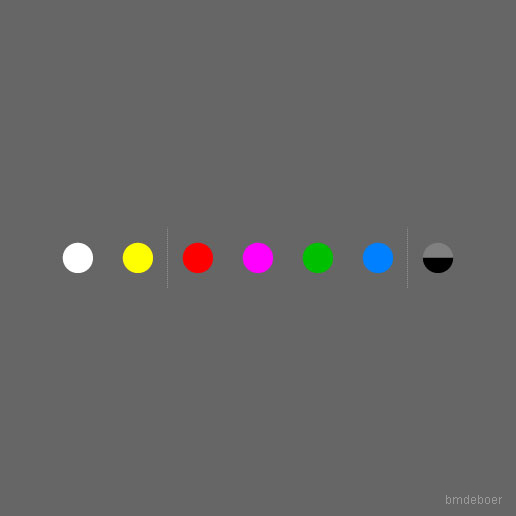
"For there are seven species of each, if, as is reasonable, we regard Dun [or Grey] as a variety of Black (for the alternative is that Yellow should be classed with White, as Rich with Sweet); while [the irreducible colours, viz.] Crimson, Violet, leek-Green, and deep Blue, come between White and Black, and from these all others are derived by mixture."
(On Sense and the Sensible)
1) leukon (white, wit)
2) xanthon (yellow, lichtgeel)
3) phoinikoun (red, rood)
4) alourgon (violet, purper)
5) prasinon (leek-green, preigroen)
6) kuanon (deep blue, blauw)
7) melanon (black, zwart) en faion (grey, grijs)
Noot: Aristoteles' indeling was zeer waarschijnlijk een vereenvoudiging van Plato's indeling (zie Plato C).