De Coloribus
Plato (A)
Plato (B)
Plato (C)
Aristoteles (A)
Aristoteles (B)
Aristoteles (interpretatie)
Pseudo-Aristoteles
Plinius de Oudere
Johannes
Claudius Ptolemeus
Chalcidius
Arabische alchemie
Picatrix (A)
Picatrix (B)
Bartholomaeus Anglicus
Roger Bacon
Thomas Aquinas
Sicille (A)
Sicille (B)
Sicille (C)
Leon Battista Alberti
Leon Battista Alberti (B)
Leonardo da Vinci
Tübinger Hausbuch
Martin Schaffner
Combinatiefiguur
Karel van Mander
Franciscus Aguilonius
Athanasius Kircher
Samuel van Hoogstraten
J.W. (von) Goethe
© Bastiaan de Boer
De Coloribus / Plato (A)
Plato (ca. 427-347 vC) – indeling A 4e eeuw vC Visualisatie (interpretatie) van de indeling -een opeenvolging van hemellichamen- genoemd in: Dialogues, Timaeus (38c-38e).
bronnen en links
|
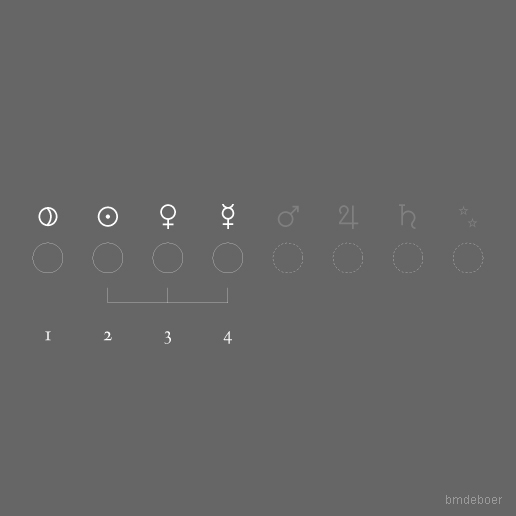
"The sun and moon and five other stars, which are called the planets, were created by him in order to distinguish and preserve the numbers of time; and when he had made their several bodies, he placed them in the orbits in which the circle of the other was revolving -- in seven orbits seven stars. First, there was the moon in the orbit nearest the earth, and next the sun, in the second orbit above the earth; then came the morning star and the star sacred to Hermes, moving in orbits which have an equal swiftness with the sun, but in an opposite direction; and this is the reason why the sun and Hermes and Lucifer overtake and are overtaken by each other."
(Timaeus)