De Coloribus
Plato (A)
Plato (B)
Plato (C)
Aristoteles (A)
Aristoteles (B)
Aristoteles (interpretatie)
Pseudo-Aristoteles
Plinius de Oudere
Johannes
Claudius Ptolemeus
Chalcidius
Arabische alchemie
Picatrix (A)
Picatrix (B)
Bartholomaeus Anglicus
Roger Bacon
Thomas Aquinas
Sicille (A)
Sicille (B)
Sicille (C)
Leon Battista Alberti
Leon Battista Alberti (B)
Leonardo da Vinci
Tübinger Hausbuch
Martin Schaffner
Combinatiefiguur
Karel van Mander
Franciscus Aguilonius
Athanasius Kircher
Samuel van Hoogstraten
J.W. (von) Goethe
© Bastiaan de Boer
De Coloribus / Plato (B)
Plato (ca. 427-347 vC) – indeling B 4e eeuw vC Visualisatie (interpretatie) van de indeling -een opeenvolging van hemellichamen en daaraan gekoppelde lichtkleuren- genoemd in: Dialogues, The Republic (Politeia), Book X (616e-617b).
bronnen en links
|
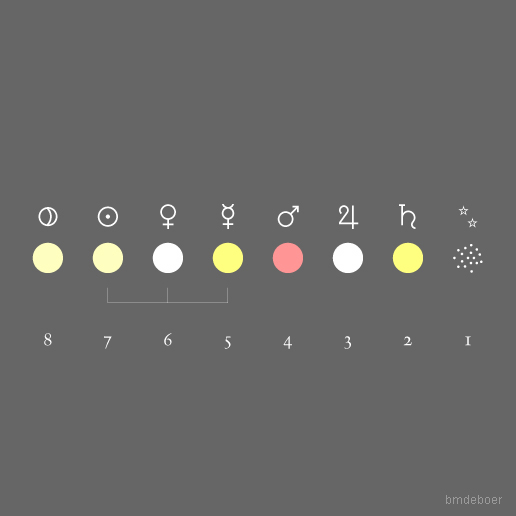
"Now the first and outmost whorl had the broadest circular rim, that of the sixth was second, and third was that of the fourth, and fourth was that of the eighth, fifth that of the seventh, sixth that of the fifth, seventh that of the third, eighth that of the second; and that of the greatest was spangled, that of the seventh brightest, that of the eighth took its color from the seventh, which shone upon it. The colors of the second and fifth were like one another and more yellow than the two former. The third had the whitest color, and the fourth was of a slightly ruddy hue; the sixth was second in whiteness. The staff turned as a whole in a circle with the same movement, but within the whole as it revolved the seven inner circles revolved gently in the opposite direction to the whole, and of these seven the eighth moved most swiftly, and next and together with one another the seventh, sixth and fifth; and third in swiftness, as it appeared to them, moved the fourth with returns upon itself, and fourth the third and fifth the second."
(The Republic, Book X)
Noot: De omschreven kleuren zijn waarschijnlijk de met het blote oog waargenomen kleuren van hemellichamen.