De Coloribus
Plato (A)
Plato (B)
Plato (C)
Aristoteles (A)
Aristoteles (B)
Aristoteles (interpretatie)
Pseudo-Aristoteles
Plinius de Oudere
Johannes
Claudius Ptolemeus
Chalcidius
Arabische alchemie
Picatrix (A)
Picatrix (B)
Bartholomaeus Anglicus
Roger Bacon
Thomas Aquinas
Sicille (A)
Sicille (B)
Sicille (C)
Leon Battista Alberti
Leon Battista Alberti (B)
Leonardo da Vinci
Tübinger Hausbuch
Martin Schaffner
Combinatiefiguur
Karel van Mander
Franciscus Aguilonius
Athanasius Kircher
Samuel van Hoogstraten
J.W. (von) Goethe
© Bastiaan de Boer
De Coloribus / Plato (C)
Plato (ca. 427-347 vC) – indeling C 4e eeuw vC Visualisatie (interpretatie) van de indeling -een uiteenzetting over kleuren- genoemd in: Dialogues, Timaeus (67d-68d).
bronnen en links
|
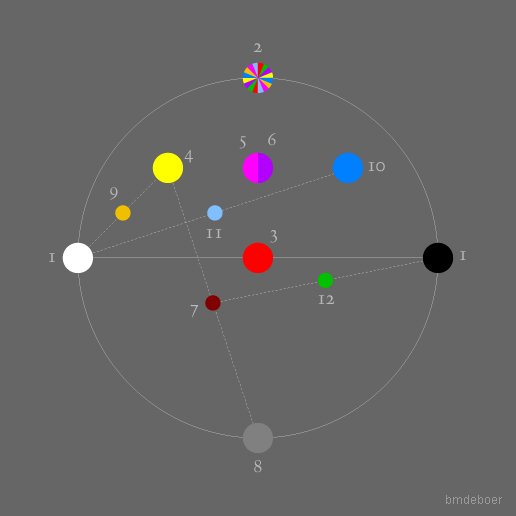
"These, therefore, are the names we must assign to them: that which dilates the visual stream is ‘white’ and the opposite thereof ‘black’ [1]; and the more rapid motion, being that of a different species of fire, which strikes upon the visual stream and dilates it as far as to the eyes, and penetrating and dissolving the very passages of the eyes causes a volume of fire and water to pour from them, which we call ‘tears’. And this moving body, being itself fire, meets fire from the opposite direction; and as the one firestream is leaping out like a flash, and the other passing in and being quenched in the moisture, in the resultant mixture colors of all kinds are produced [2]. This sensation we term ‘dazzling’ and the object which causes it ‘bright’ or ‘brilliant’. Again, when the kind of fire which is midway between these reaches to the liquid of the eyes and is mingled therewith, it is not brilliant but, owing to the blending of the fire's ray through the moisture, it gives off a sanguine color, and we give it the name of ‘red’ [3]. And ‘bright’ color when blended with red and white becomes ‘yellow’ [4]. But in what proportions the colors are blended it were foolish to declare, even if one knew, seeing that in such matters one could not properly adduce any necessary ground or probable reason. Red blended with black and white makes ‘purple’ [5]; but when these colors are mixed and more completely burned, and black is blended therewith, the result is ‘violet’ [6]. ‘Chestnut’ [7] comes from the blending of yellow and grey; and ‘grey’ [8] from white and black; and ‘ochre’ [9] from white mixed with yellow. And when white is combined with ‘bright’ and is steeped in deep black it turns into a ‘dark blue’ color [10]; and dark blue mixed with white becomes ‘light blue’ [11]; and chestnut with black becomes ‘green’ [12]. As to the rest, it is fairly clear from these examples what are the mixtures with which we ought to identify them if we would preserve probability in our account."
(Timaeus)
1) tegenstelling wit (leukos) en zwart (melas)
2) pur + pur = mengsel van allerlei kleuren
3) rood (eruthros)
4) geel (xanthos)
5) purper, roodpaars (halourgos)
6) violet, blauwpaars (orphnios)
7) kastanjebruin, roodbruin (purrhos)
8) grijs (phaios)
9) oker (oochros)
10) donkerblauw (kuaneos)
11) lichtblauw (glaukos)
12) groen (prasinos)
Noot: Het ontstaan van roodbruin uit het mengen van geel en grijs is merkwaardig, en het ontstaan van groen uit het mengen van roodbruin en zwart is bijzonder vreemd. Logisch zou zijn dat met purrhos een bepaalde kleur groen (of geel) wordt bedoeld die dan vermengd met zwart 'preigroen' oplevert.